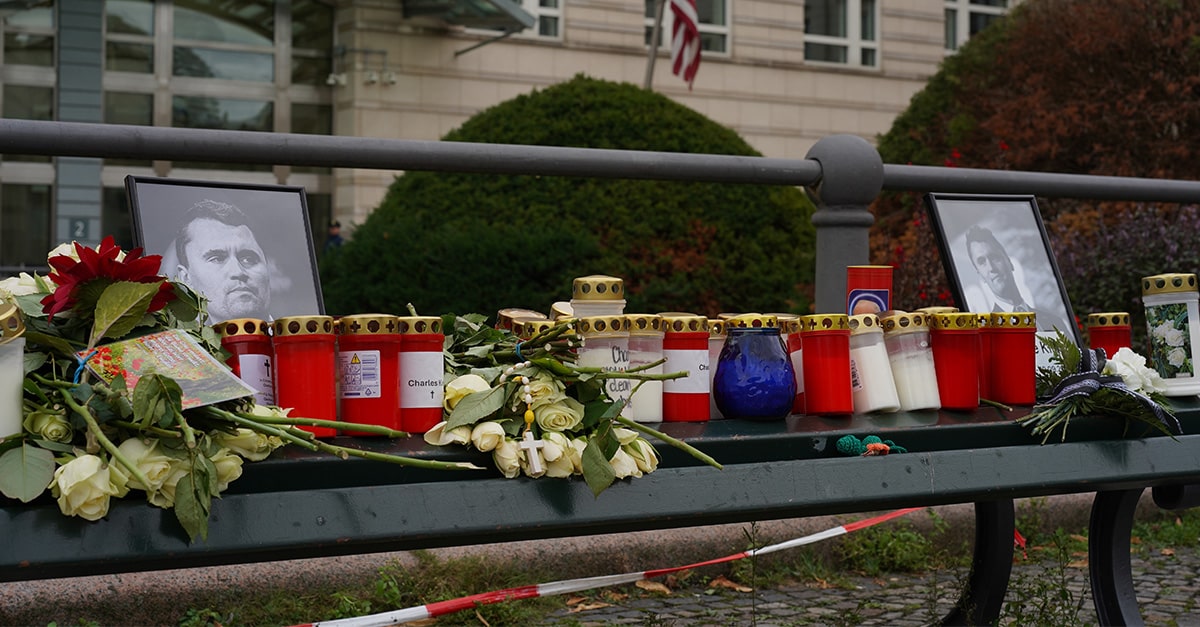
Charlie Kirk’s assassination demands that we pick up his “bloody microphone” and carry on his mission to go boldly into the public square and proclaim that the Christian faith must ground, inform, and rule our lives and our politics.
The Christian philosopher Soren Kierkegaard once said, “The tyrant dies, and his rule is over. The martyr dies, and his rule begins.”
Last Wednesday, Charlie Kirk’s rule began, as he was martyred in cold blood by yet another radical LGBTQ terrorist.
And make no mistake, Charlie Kirk did die a Christian martyr.
Charlie wasn’t a racist, fascist, Nazi, homophobe, transphobe, or any of the other disgusting epithets hateful Leftists are trying to use to smear his name and tarnish his legacy.
He was a husband, father, son, patriot, free speech champion, debater, successful political strategist, and, above all else, a Christian.
But not just any kind of Christian. Charlie wasn’t the weak, soft, woke Christian we’ve come to expect in today’s modern era, the kind who twists themselves in knots anytime they have to defend a “hard” teaching of Christianity — like that transgenderism is a wicked fiction, marriage is between a man and a woman, and babies shouldn’t be killed in the womb.
No, Charlie Kirk was a lion of the faith, roaring in front of the entire world, and even those who hated him, that the Christian faith must ground, inform, and rule our politics, no apologies required.
And he was killed for it.
Like many martyrs, he was publicly executed to make a point. Tyler Robinson gunned him down in front of a crowd of more than 3,000 students to send a message: “Dear normal Christian, if you won’t be silent, you’re next.”
Some people ask, “Was he murdered for his Christian faith or for his conservative political views?”
If you watch any of his videos, you know the answer is both.
Why? Because Charlie didn’t separate the two. Fundamentally, it was his Christian beliefs that informed his political beliefs, and not the other way around. Which means he was killed for his faith.
Kirk’s Christianity wasn’t window dressing for his conservatism — it was the fuel of his public fight against the sacred cows of our anti-Christian age.
To dub Kirk a martyr is to place him in the company of those who’ve watered the tree of liberty with something far richer than patriot blood — the blood of the Lamb’s witnesses.
Recall Jim Elliot, that young missionary who scribbled in his journal about not being a fool for trading the temporal for the eternal, only to have his life punctured by spears in the Ecuadorian wilds. Elliot perished bringing light to the Auca darkness, his death a seed that sprouted churches among his killers.
Kirk, in the concrete jungles of American campuses and government centers, laid down his life exposing the darkness that parades as enlightenment, calling out the principalities that feast on innocence and twist human flourishing into grotesque caricatures.
Or take John the Baptist, that wild man of the Jordan, who had his head separated from his body simply for daring to tell a king that he had defiled his marital bed.
Kirk echoed that prophetic thunder, naming names and sins among the Left, undeterred by the gathering storm clouds of cancellation, government investigations, and death threats.
These witnesses weren’t thrill-seekers chasing glory; they were faithful servants who counted the cost and paid it gladly.
Kirk fits the pattern: a disciple dispatched for testifying to the Lordship of Jesus Christ in the arena where it matters most.
A Modern Day Stephen
If you’re looking for a scriptural parallel to Charlie Kirk’s death, look no further than Stephen, the inaugural martyr of the newborn Christian church, whose tale unfolds in Acts 6 through 8 like a divine drama scripted to shame the timid.
The scene opens with the apostolic band overwhelmed by growth — widows grumbling about uneven handouts, the mundane rubbing shoulders with the miraculous.
Wisely, the twelve apostles tapped seven men brimming with the Spirit for the grunt work, Stephen at the fore. But this deacon wasn’t your average table-waiter. He was “full of grace and power,” performing signs that left the crowds amazed (Acts 6:8).
Like Charlie and his tours of secular college campuses, Stephen went where the message of Christ crucified and resurrected would be hated most.
For Stephen, that meant heading into the synagogues, where he dismantled the arguments of the Pharisees with logic and Scripture.
The anti-Christ establishment of the time couldn’t stomach it. Outmatched in fair debate, they trotted out the slanderers: “This man ceaseth not to speak words against this holy place, and the law” (Acts 6:13). Sound familiar?
Kirk prowled the same intellectual coliseums, eviscerating the pretensions of progressive dogmas of our day. He took aim at the DEI juggernaut that masks envy as equity, the gender-bending lunacy that spits in the face of Genesis 1:27, the profligate spending that mortgages our children’s future to the god of “More.”
Like Stephen, Kirk didn’t murmur in safe spaces; he bellowed from podiums, mobilizing a generation to reclaim the republic under the banner of biblical truth.
When the high priest demanded, “Are these things so?”, Stephen didn’t hedge or triangulate. He unloaded a tour de force of redemptive history, from Abraham’s call to Solomon’s temple, climaxing with a scorching indictment: “Ye stiffnecked and uncircumcised in heart and ears, ye do always resist the Holy Ghost” (Acts 7:51).
Kirk operated in the same vein, weaving Scripture into his arguments, framing every policy debate as part of the spiritual clash between light and darkness.
At Stephen’s accusation, the council members gnashed their teeth in fury, mirroring the seething of our cultural overlords at Kirk’s unrelenting exposure.
Stephen’s curtain call was savage: hauled beyond the gates and pelted with stones while he beheld the glory, the Son of Man standing to receive him (Acts 7:55-56). His parting shot? A plea for mercy on his executioners.
After Stephen’s death, the early Church didn’t wallow in victimhood over his death; they interred him with dignity and then went out in force, the martyr’s blood fertilizing explosive growth in Christianity, as Tertullian would later observe.
And haven’t we seen the same thing with Charlie? Last week, thousands and thousands of Americans went to church for the first time in ages, and many were saved.
How To Honor Charlie’s Martyrdom
Martyrdom, properly understood, isn’t just a somber moment or a call to mourn without hope; it’s a trumpet blast, rousing the Church from her slumber.
From Polycarp’s death in Smyrna’s arena to the Reformers being burned at the stake at Smithfield, the spilled blood of the faithful ignites a Kingdom advance.
Acts bears witness to this phenomenon: Stephen’s stoning unleashes Philip’s Samaritan fireworks and the Ethiopian’s waterway conversion. Foxe’s chronicles detail how Cranmer’s flames ignited England’s Protestant blaze.
Kirk’s murderer thought he’d silence those who oppose Leftism. He was wrong. More and more Americans and Christians are speaking up. Just days after Charlie’s murder, his campus ministry, Turning Point USA, announced that it had received more than 54,000 applications for new student chapters at high schools and colleges.
So, what’s the fitting tribute to Charlie Kirk? Not reliquaries or rote invocations — that’s the papist detour, and we’re heirs of the Reformation. We don’t canonize Charlie Kirk or mutter intercessions to his statue. Instead, we hold him out as a model and an example for our own lives. The old Puritans put it this way: Emulation, not veneration.
The paramount takeaway from his witness? And that’s what a martyr is, a witness. I think it’s this: Christians must drag their convictions into the political fray like never before.
We’ve dawdled too long in our ecclesiastical bunkers, letting secularists warp “church-state separation” into a gag order on the Gospel.
Kirk didn’t live like that. His creed shaped every position he held, and he let the world know it without ever once apologizing or caveating it as “his truth.”
No, he knew that Christian truth is THE truth.
Charlie’s “bloody microphone” demands that we all pick it up and carry on his mission. Let it kindle our resolve to make America Christian again.
Remember, to live is Christ and to die is gain (Philippians 1:21). Charlie has gained. We still live. Let’s follow Charlie as he followed Christ.
Yes, honor him as a Christian martyr. Then get off the sidelines and retrace his steps into the arena — and boldly proclaim the Gospel to our lost American society.
If you like this article and other content that helps you apply a biblical worldview to today’s politics and culture, consider making a donation here.