What happened at a Ventura city council meeting highlights a critical truth: When government officials attempt to silence religious expression in public, they are not creating a neutral space — they are replacing faith with a secular worldview.
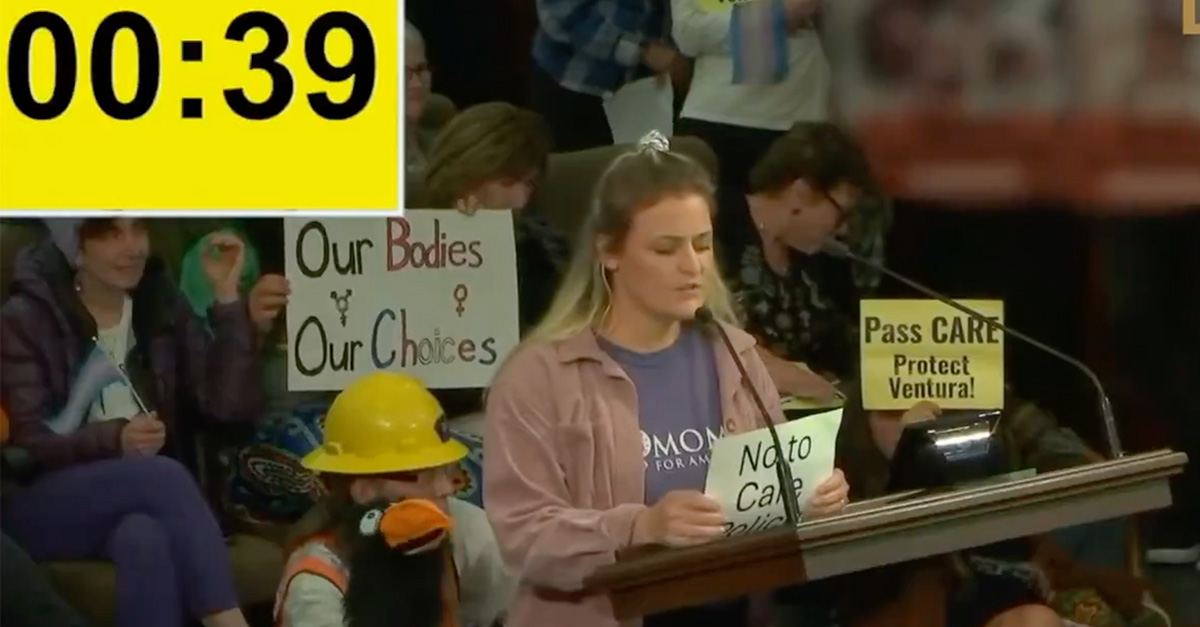
Jeannette Sanchez-Palacios, mayor of Ventura, California, stopped a Christian mother from praying during her time for public comments at a March 18 city council meeting, stating, “We don’t do prayer.”
Tarin Swain, the only one of 100 speakers who was interrupted and asked to censor her comments during the meeting, is now seeking an apology from the city and a guarantee that future speakers will be allowed to pray during their allotted time.
First Liberty Institute, a nonprofit legal organization dedicated to defending religious freedom, sent the demand letter to city leaders on her behalf.
Swain appeared at the meeting to voice her opposition to the proposed Community Autonomy, Rights, and Equality (CARE) Policy.
If enacted, the measure would designate the City of Ventura as a “sanctuary city” for abortion, referred to in the policy as “reproductive rights,” and the promotion of LGBT ideology among minors.
The ordinance states, in part, “The City of Ventura and its law enforcement agencies shall not: Participate in the enforcement of any federal or state law that criminalizes or restricts access to reproductive healthcare or gender-affirming care for adults or minors, provided such care is delivered with the approval of a licensed healthcare provider and, in the case of minors, with parental consent in accordance with current California state law.”
Swain says that staff members at her daughter Penny’s school “changed her name and gender in classes and told her it would be kept from me” and that “teachers recommended her inappropriate male homosexual ‘coming-of-age’ books without my consent.”
Swain opened her remarks before the city council by stating, “I am a mother of six, and the Ventura County Public Schools socially transitioned my daughter without my consent.” She added, “I’ve come here today to offer nothing but prayer, and I want to lift up my Father in Heaven.”
She then prayed aloud:
“Father God, I just come to you in Jesus’ name. I pray, Father, that you would tear down the strongholds in this place. I pray, Father, that you would raise up the men in this room.”
As the crowd grew louder with boos and interruptions, Swain attempted to complete her prayer. Mayor Sanchez-Palacios eventually stepped in, banging the gavel and calling for order. “We don’t do prayer,” she stated. “Please finish your comments.”
Despite the noise and attempts to cut her off, Swain finished her prayer, declaring,
“I do pray all this in the name of the Jesus, the Son, the Father, and the Holy Spirit. … Jesus is the King of kings and He is the Lord of lords.”
Swain later explained that prayer had not been her original intention when addressing the council, but that changed when she learned she would have limited time to speak.
“I hadn’t planned to pray, but when I learned that I only had one minute to speak, I knew that my prepared comments were too long,” she said. “In that moment, I asked God what He wanted me to do with my 60 seconds. I felt the Holy Spirit prompt me to use my time for prayer, and so that’s what I did.”
The mayor’s interruption caught her by surprise.
“At first, I couldn’t even hear the mayor telling me to stop because the crowd behind me was so loud,” Swain said. “I had a man from the community come up to me afterward and express that in his years of attending hundreds of Ventura City Council meetings, he’s never seen someone stopped from praying. To me, it was a proof point for the power of prayer.”
First Liberty Institute warns that these threats are not about true equality but instead represent a strategic effort to erase religious expression from the public square altogether, altering a practice that has existed since the nation’s founding.
“This is not about expanding inclusivity,” said Jeremy Dys, senior counsel at First Liberty. “This is about silencing religious speech and marginalizing faith communities under the guise of neutrality. The Constitution protects the right to pray — it does not mandate the elimination of prayer simply because some groups wish to mock or disrupt it.”
He continued,
“The solution to a diversity of religious beliefs is not to ban prayer. The answer is to respect the religious freedom of every American — including the freedom to pray publicly according to one’s faith.”
Numerous U.S. Supreme Court rulings — including First Liberty’s major win in Kennedy v. Bremerton School District — have affirmed that government entities must give religious viewpoints the same respect as secular ones. When a city permits secular speech during public comment periods, it cannot lawfully prohibit religious speech or prayer.
First Liberty attorneys note that city councils can safeguard their prayer practices by adopting neutral policies. These typically involve inviting community leaders on a rotating basis, opening opportunities to various faiths without dictating the content of prayers or setting quotas based on religious affiliation. Under such systems, participation is voluntary, and local leaders are not censored for the religious character of their invocations.
They also stress that the First Amendment protects citizens’ right to respectfully refrain from participating in prayers — a point long recognized in legal doctrine. Forcing silence or conformity is unconstitutional, as is compelling governments to purge religious expression from public life.
As culture grows more divided on matters of faith, religious liberty advocates warn that public prayer will remain a flashpoint for litigation and controversy. But they argue that the stakes are far greater than a few moments of prayer at a meeting. At issue is whether America will continue to honor a heritage of religious freedom that includes public acknowledgment of faith — or whether secularism will be treated as the only acceptable worldview in civic spaces.
“Prayer in public meetings is a tradition older than our Republic,” said Dys. “We should not surrender it lightly to those who seek to silence faith altogether.”

The confrontation at the Ventura City Council meeting is a powerful reminder that religious freedom, once considered a foundational right in America, is increasingly under pressure.
We have now reached the point where the leaders of an American city will allow 99 secular speakers to say whatever they want but then attempt to shut down a Christian mother using her brief time at the podium to lift up a prayer to God.
Yet Swain’s boldness to follow the prompting of the Holy Spirit demonstrates what it means to live out one’s faith publicly, even in the face of opposition.
As believers, we are called not to shrink back when our freedom to live and speak our faith is challenged. Scripture reminds us, “Blessed are those who are persecuted because of righteousness, for theirs is the kingdom of heaven” (Matthew 5:10). Religious freedom is not simply the right to worship privately; it is the ability to live out our faith openly in every sphere of life, including government settings.
What happened in Ventura highlights a critical truth: secularism is not neutral. When government officials attempt to silence religious expression, they are not creating a neutral space; they are replacing faith with a secular worldview.
Christians must be vigilant, understanding that defending the right to pray in public is about protecting the broader right to live out the Gospel in a culture that often rejects it. We should take encouragement from Swain’s courage — and pray for more believers willing to stand firm.
If you like this article and other content that helps you apply a biblical worldview to today’s politics and culture, consider making a donation here.